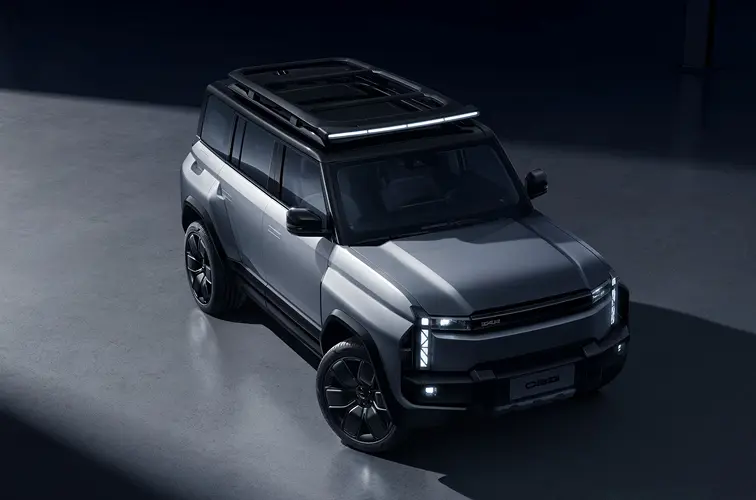
The all-new iCAUR 03T electric SUV is set to arrive in South Africa in 2026, and the brand has now detailed the advanced engineering and manufacturing systems behind its development.
As a new-energy off-road adventure marque under the Chery Group, iCAUR positions the 03T as a globally tested electric SUV engineered for durability and lightweight performance, with AI-driven production precision.
Here’s a technical breakdown of what underpins the iCAUR 03T electric SUV ahead of its South African launch.

Global Durability Testing for Extreme Conditions
Before entering international markets, including South Africa, the iCAUR 03T undergoes an extensive durability and quality validation programme. The electric SUV is tested in simulated extreme environments to ensure long-term reliability across diverse climates and terrains.
Testing includes exposure to:
• Severe high and low temperatures
• High-humidity conditions
• Dust-intensive environments
• Uneven and off-road terrain
These evaluations focus on corrosion resistance, sealing integrity, structural rigidity, electric power system performance, and material stability. By replicating real-world global conditions, iCAUR aims to verify the 03T’s structural integrity and electric drivetrain durability before customer delivery.
For the South African market, where vehicles often face high temperatures, long distances, and mixed-surface driving, this global validation programme is a key part of the 03T’s engineering strategy.

Full Aviation-Grade Aluminium Body Structure
At the core of the iCAUR 03T electric SUV is a full aluminium body construction. Unlike conventional steel-based platforms, the 03T uses 6-series aviation-grade aluminium, selected for its high strength-to-weight ratio and corrosion resistance.
Lightweight aluminium construction contributes to improved structural efficiency and overall vehicle performance, while also supporting electric vehicle range optimisation.
The body structure integrates multiple advanced joining technologies:
• MIG arc welding
• Self-piercing riveting (SPR)
• Flow-drill screw (FDS) fastening
• Laser deep fusion welding
All 237 critical structural connection points utilise SPR technology. This non-thermal joining method bonds aluminium and high-strength steel without heat distortion, enhancing durability and long-term corrosion resistance compared to traditional spot welding.
In high-load areas such as the roof structure, FDS fastening ensures assembly precision with tolerances as tight as 0.2 millimetres. Laser deep fusion welding is used at automated stations to bond aluminium profiles to sheet metal components, a process typically associated with premium vehicle manufacturing standards.
The result is a lightweight yet rigid aluminium-intensive body engineered to meet global safety and durability benchmarks within the electric SUV segment.

AI-Driven Manufacturing at Chery’s South Smart Factory
Production of the iCAUR 03T takes place at Chery’s South Smart Factory in China, one of the few facilities capable of large-scale full aluminium body manufacturing.
The plant operates with 100% automation across critical production stages and incorporates AI-based visual inspection systems. Each vehicle body undergoes inspection at:
• 105 critical welding points
• 436 dimensional measurement points
An in-house IoT-based quality monitoring platform tracks more than 100,000 data points in real time across the production line. This system provides full traceability from raw material intake to final assembly, ensuring consistent manufacturing standards.
During chassis assembly, smart torque tools digitally record torque angle and applied force on 26 critical fasteners per vehicle. This eliminates reliance on manual estimation and ensures fastening precision across every unit produced.
AI-enabled inspection and real-time data analytics form a central pillar of the 03T’s production methodology, reinforcing consistency and structural accuracy.

Reduced-Energy Manufacturing and Renewable Integration
Beyond structural engineering, the iCAUR 03T’s production process incorporates energy-efficient manufacturing systems aligned with new-energy vehicle principles.
The aluminium body structure eliminates the need for a traditional paint shop, reducing energy consumption by 82.9% compared to conventional automotive manufacturing processes. This significantly lowers production-related energy demand.
Additionally, the factory integrates a photovoltaic power system that enables 100% daytime operations powered by renewable electricity. This renewable integration supports reduced carbon intensity during manufacturing.

As iCAUR prepares for its South African debut in 2026, the 03T establishes the brand’s technical foundation within the growing electric SUV segment. Its lightweight aluminium architecture, precision assembly standards, and reduced-energy production methods position it as a structurally advanced entrant in the new-energy off-road category.
Further details regarding specifications, drivetrain configuration, and local market positioning are expected closer to the official South African launch.